
traits, trials, and trouble: what’s missing from the GM corn rollout
technical gaps and regulatory blind spots still threaten biotech rollout credibility

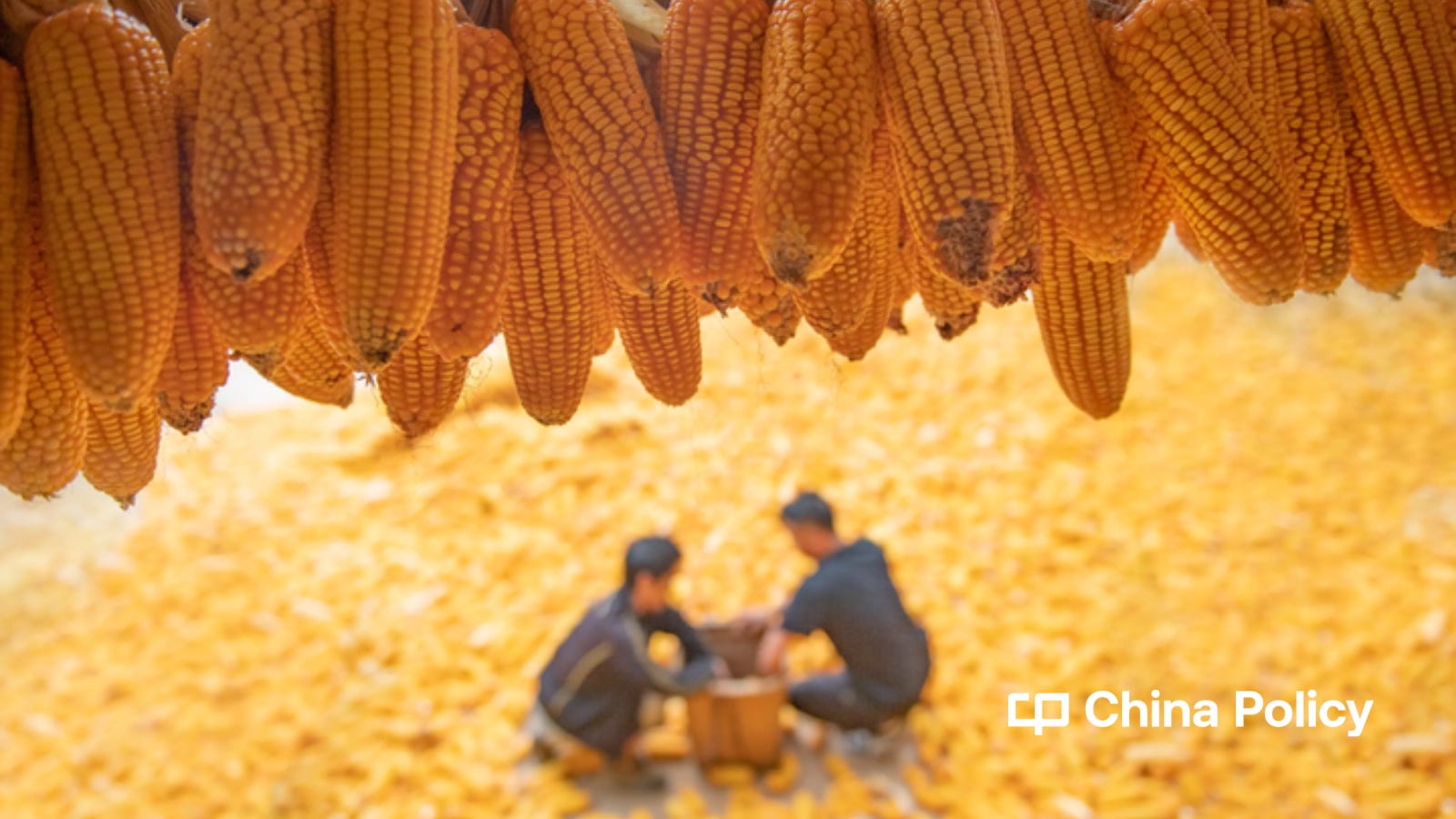
Pillar two of the 2024–2035 Agricultural Powerhouse Plan targets breakthroughs in agri science, especially seed innovation and biotech. The 2025 No.1 Document reinforced that direction, calling for increased per-mu yields and accelerated rollout of high-performing seed varieties.
An April Reuters piece captured the stakes: acreage set to quadruple, pesticide use cut, and soybean import dependence challenged
But rollout is unfolding in stages, calibrated to risk and reception.
beyond acreage and ambition

Beijing’s three-phase GM rollout, laid out in 2016, remains the frame
non-edible crops: tobacco, cotton
indirect consumption: livestock feed, edible oil
direct consumption: GM soybeans, grains, vegetables
Step two is already well underway.
Soy oil now made up 40 percent of edible oil consumption by 2022/3, and most is GM. But moving to step three—GM foods on supermarket shelves—remains politically and socially fraught.
Restricting domestic GM use while consuming GM imports is unreasonable, argued Liu Chunming 刘春明, Peking University School of Advanced Ag Sciences dean, in December 2023.
But a sceptical public still needs convincing.
MARA has stepped up messaging. In 2023, it issued a Q&A declaring all approved GM foods safe. A 2024 WeChat campaign answered questions like
why do insects die from GM corn, but humans don’t?
why are GM foods safe in the US and EU?
can consumers choose non-GM options?
Long-term safety fears persist—fuelled by rumour, not data.
Missteps would be irrecoverable, warns Shen Zhicheng 沈志成, Zhejiang University GM R&D director.
MARA trials report average yield gains of 8–10 percent in typical years and up to 20 percent during severe pest infestations.
But the results vary by region, with farmers noting that yield gains are often too subtle to be immediately visible, fuelling mixed perceptions.
Inner Mongolia’s Chifeng City saw GM corn planting reach 83,593 ha in 2024, up over 13,000 ha y-o-y.
Yet scepticism remains, especially among livestock farmers who report harder kernels and lower milling yields. These, they believe, reduce feed quality and palatability, potentially affecting livestock birth rates.
Economic factors remain critical to adoption. GM seeds cost C¥60–90/acre more than conventional varieties.
MARA claims reduced pesticide use cuts costs by around C¥60/acre, with further savings: glyphosate resistance means applying herbicides 2–3 fewer times and harvest losses drop to about 5 percent, compared to 8–15 percent for conventional corn.
Addressing concerns will be essential to secure broader adoption and productivity gains as the GM corn program scales up.
In this context, systems—not slogans—will decide the success of GM ambitions.
more events, more overlap
To date Beijing has approved 20 GM corn events, with 161 varieties passing national review. Most are transgenic upgrades of conventional lines, leading to significant trait overlap and limited varietal differentiation.
The result: a crowded market of ‘me-too’ hybrids, many offering only marginal gains over conventional predecessors. Speed to market has trumped agroecological fit—risking long-term credibility among growers.
Seed inventories doubled y-o-y in 2025, notes Agropages, as mid-tier firms face growing cash flow stress.
While large players like Fengle posted 70 percent profit growth in 2024 on strong GM sales, saturation is setting in. A lot of firms are sitting on stock they can’t move.
unstable traits in the field
Field trials from 2022 to 2024 reveal persistent flaws
unstable trait expression
low genetic recovery
occasional gene loss
Some producers skip GM-specific protocols like field isolation, detasseling, or traceable post-harvest handling, complicating both farmer adoption and regulatory traceability.
And they’re not new.
Back in 2016, Greenpeace East Asia’s Li Yifang 李一方 flagged illegal GM corn cultivation in Liaoning as evidence of regulatory failure on multiple levels.
when oversight fails
Regulatory credibility took another blow in 2024.
In September, seven batches of PRC-processed food bound for the EU were recalled due to unauthorised GM content—six rice-based, one soy-based. The PRC has not approved any GM rice for commercial cultivation.
Gaps in seed tracking, oversight, and enforcement are not new.
In 2005, illegal GM rice entered the Hubei market.
In 2014, CCTV investigations confirmed unapproved GM rice in public circulation.
The issue goes beyond biotech.
In April 2024, a China National Radio exposé uncovered widespread sale of counterfeit and unapproved seeds in Heilongjiang, including
fake DiKa-branded varieties
rented seed production licences
unapproved Peiyu 216 seeds lacking packaging codes
The journalist found sellers marketing unapproved seeds, misleading farmers about the seeds' origins and quality.
If farmers can’t trust what’s in the bag, how can the public trust what’s on the plate?
resetting seed oversight, again
The 2025 national seed regulation and enforcement action plan is Beijing’s latest attempt to tighten control—following years of intermittent crackdowns and guidance documents. It promises
stronger seasonal inspections and targeted crackdowns
tighter controls on cross-regional and online sales
coordinated complaints systems and variety verification tools
But structural gaps persist—from weak coordination to murky definitions.
Jing Fei 靖飞, Bohai University’s School of Management dean, notes difficulties in defining infringement, limited inter-agency cooperation, and weak detection in fragmented or digital channels.
MARA has identified 270 ‘anchor’ seed firms and launched enterprise–university R&D alliances.
Du Lilong 杜黎龙, State Investment Seed Industry general manger, sees progress but calls for
greater genetic diversity
increased international exchange
long-term investment in AI breeding and gene editing
Yet with most approved events still clustered around similar traits, the lack of functional diversity in the seed market continues to frustrate many efforts at genuine innovation.
Variety names may change, but the underlying capabilities often remain indistinct.
standards lag, trust stalls
To support rollout, MARA launched a ‘green channel’ to fast-track high-performing varieties and promote regionally adapted trials in 2022. But enforcement remains uneven.
Local regulators often lack the technical capacity and political backing to enforce tighter standards.
Huang Jikun 黄季焜, Peking University, estimates that full GM corn commercialisation could add C¥53.4 bn to GDP over two years and cut pesticide use by more than half. Execution, not approval, is the weak link.
The seed industry lag is no single 'choke point' issue, warns Bao Xiaoming 鲍晓明 Guorui Biotech chief scientist. It’s a systemic drag, one no magic bullet can fix.
He recommends
genetic recovery: use full-genome marker systems (beyond basic SSR testing)
trait validation: multi-zone trials to confirm expression stability
seed production: standardised isolation, purity, and traceability protocols
scaling up, hedging bets
Firms like Longping High-Tech are attempting to meet the moment.
Backed by CITIC and powered by biotech, Longping reported C¥8.566 bn in revenue and continued GM-driven growth 2024. It runs over eight breeding stations and channels 10 percent of revenue into R&D, including hybrid and gene-edited lines.
Chair Liu Zhiyong 刘志勇 points to stress resistance and pest resilience as core differentiators. Yet even Longping—with state backing—is hedging its international bets in Brazil, deploying syndicated loans and FX hedges to stabilise operations.
systems, not slogans, will decide success
Behind headline acreage gains and media campaigns, the real test lies in systems and standards. Enforcement remains inconsistent, particularly at the local level.
Public confidence hinges less on scientific data and more on perceived regulatory credibility. MARA, provincial regulators, and seed firms face a narrowing window to close technical gaps and build trust.
The next phase will demand more than approvals and marketing. It will require traceability, genetic stability, and robust local enforcement.
Until quality assurance systems match policy ambition, GM acceptance in staple food markets will remain on shaky ground.